
Academic research has undergone a remarkable transformation over the past decade. In 2026, the rise of big data, artificial intelligence, machine learning, and cloud computing has fundamentally changed how researchers collect, analyze, and interpret information.
Gone are the days when scholars relied solely on spreadsheets and manual calculations. Today’s researchers leverage sophisticated statistical software to process massive datasets, identify patterns, test hypotheses, and generate evidence-based conclusions with unprecedented speed and accuracy.
Whether a doctoral candidate is conducting healthcare research, a business student is examining consumer behavior, or a social scientist is studying demographic trends, statistical software has become an indispensable part of the research process.
The Growing Importance of Data-Driven Research
The United States continues to lead global research output, producing thousands of peer-reviewed studies annually. According to the National Science Foundation (NSF), research and development spending in the U.S. exceeded $940 billion in recent years, reflecting a growing emphasis on evidence-based decision-making across industries.
As research questions become increasingly complex, scholars need tools capable of managing large volumes of quantitative data. Statistical software enables researchers to:
- Clean and organize datasets
- Perform descriptive and inferential analyses
- Conduct regression modeling
- Test research hypotheses
- Create visual representations of findings
- Improve reproducibility and transparency
These capabilities have significantly elevated the quality and reliability of academic research.
Why Universities Are Prioritizing Statistical Software Skills
Employers increasingly seek graduates who can work with data. As a result, universities across the United States have expanded coursework related to statistics, analytics, and research methodology.
Many students encounter challenges when learning advanced statistical concepts, particularly when working with specialized software packages. To navigate these complexities, many researchers and students seek professional guidance through resources such as stata assignment help, especially when conducting regression analysis, panel data modeling, econometrics, or large-scale research projects.
By integrating software training into curricula, institutions are preparing students for careers where data literacy is no longer optional but essential.
Key Ways Statistical Software Is Changing Research
1. Faster Data Analysis
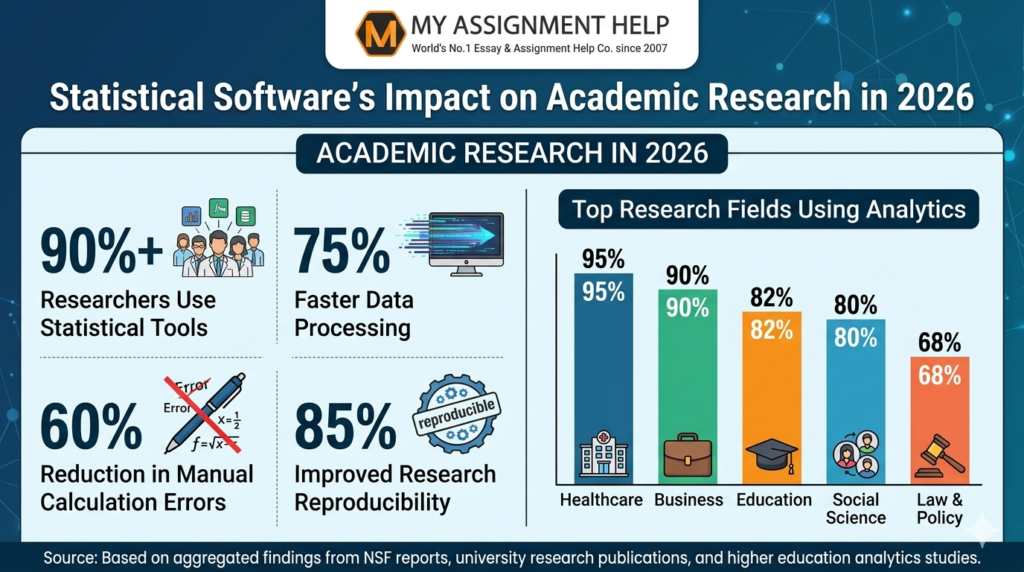
Modern software platforms can process thousands—or even millions—of data points within minutes.
Researchers studying public health trends, economic indicators, or educational outcomes no longer need weeks to complete calculations manually. Automated statistical procedures enable scholars to focus more on interpretation and theory development.
This increased efficiency has accelerated publication timelines and improved research productivity.
2. Enhanced Accuracy and Reliability
Human error remains one of the biggest threats to research quality. Statistical software reduces calculation mistakes by automating analytical procedures.
Researchers can perform:
- T-tests
- ANOVA
- Regression analysis
- Factor analysis
- Time-series modeling
- Predictive analytics
with far greater precision than manual methods.
As academic journals place increasing emphasis on methodological rigor, software-assisted analysis helps ensure findings meet high scholarly standards.
3. Supporting Interdisciplinary Research
One of the most significant developments in 2026 is the rise of interdisciplinary research.
Today’s challenges—such as climate change, healthcare disparities, cybersecurity risks, and educational inequality—require collaboration across multiple fields.
Statistical software allows researchers from diverse disciplines to analyze shared datasets and generate comprehensive insights.
For example:
- Healthcare researchers combine medical and demographic data.
- Business scholars integrate consumer and economic indicators.
- Education researchers analyze student performance metrics.
- Legal scholars examine judicial trends and policy outcomes.
Researchers involved in legal studies often require both quantitative analysis and strong academic writing support. In such cases, obtaining help with law coursework can assist students in effectively connecting statistical evidence with legal reasoning and policy evaluation.
4. Improving Research Reproducibility
Reproducibility has become a major concern in academia.
Researchers are increasingly expected to share:
- Data sources
- Methodologies
- Statistical procedures
- Analytical code
Statistical software facilitates transparent workflows, allowing other scholars to verify findings and replicate studies.
This transparency strengthens trust in research outcomes and contributes to the overall integrity of academic scholarship.
The Role of Artificial Intelligence in Statistical Analysis
Artificial intelligence is reshaping how statistical software functions.
Modern platforms increasingly include:
- Automated model recommendations
- Predictive analytics
- Pattern recognition
- Data cleaning assistance
- Natural language querying
AI-powered capabilities help researchers uncover relationships that might otherwise remain hidden within complex datasets.
According to industry analysts, AI-driven analytics adoption in higher education research continues to grow significantly as institutions seek faster and more accurate insights.
Industries Benefiting from Academic Statistical Research
Healthcare
Healthcare researchers use statistical software to:
- Analyze patient outcomes
- Evaluate treatment effectiveness
- Monitor disease trends
- Support clinical trials
Data-driven healthcare research directly influences policy decisions and medical advancements.
Business and Economics
Researchers use statistical modeling to:
- Forecast market trends
- Assess consumer behavior
- Evaluate investment performance
- Analyze economic indicators
These insights help organizations make informed strategic decisions.
Education
Educational researchers rely on analytics to:
- Measure student achievement
- Evaluate instructional methods
- Assess institutional effectiveness
Evidence-based educational policies increasingly depend on quantitative findings.
Law and Public Policy
Legal scholars use statistical methods to examine:
- Sentencing patterns
- Policy effectiveness
- Judicial behavior
- Legislative outcomes
Data analytics is becoming an increasingly valuable component of legal research and policymaking.
Challenges Researchers Still Face
Despite technological advances, several challenges remain.
Learning Curve
Many students struggle to master advanced statistical concepts and software functionalities.
Data Quality Issues
Poor-quality data can lead to inaccurate conclusions regardless of analytical sophistication.
Ethical Considerations
Researchers must address concerns related to:
- Data privacy
- Algorithmic bias
- Transparency
- Responsible AI use
Universities continue to strengthen research ethics training to address these concerns.
Future Trends to Watch
Several emerging trends will likely shape the next phase of academic research:
Cloud-Based Research Environments
Researchers can collaborate globally using shared datasets and cloud analytics platforms.
Real-Time Data Analysis
Continuous data streams enable immediate insights in fields such as public health and economics.
Automated Reporting
AI-generated summaries and visualizations reduce administrative workload.
Greater Accessibility
User-friendly interfaces are making advanced analytics accessible to researchers with limited technical backgrounds.
These developments will further democratize data-driven research and expand opportunities for innovation.
See also: How Trichoscopy Changes a Hair Loss Diagnosis
Conclusion
Statistical software has become a cornerstone of academic research in 2026. By improving efficiency, accuracy, transparency, and analytical depth, these tools empower researchers to address increasingly complex questions across disciplines.
As universities continue emphasizing data literacy and evidence-based inquiry, proficiency in statistical software will remain a critical skill for students, academics, and professionals alike.
Researchers who embrace modern analytical technologies are better positioned to produce impactful scholarship, contribute meaningful insights, and succeed in an increasingly data-driven world.
Frequently Asked Questions (FAQs)
What is statistical software used for in academic research?
Statistical software helps researchers organize data, perform analyses, test hypotheses, generate visualizations, and interpret findings accurately.
Why is statistical software important for students?
It improves analytical capabilities, enhances research quality, and prepares students for careers that require data-driven decision-making.
Which academic fields use statistical software the most?
Healthcare, business, economics, education, social sciences, psychology, engineering, and law are among the leading users.
How does AI improve statistical analysis?
AI automates data cleaning, identifies patterns, recommends analytical models, and accelerates complex calculations.
Will statistical software replace researchers?
No. Statistical software enhances human capabilities but cannot replace critical thinking, domain expertise, ethical judgment, and interpretation.
References
- National Science Foundation (NSF) – Science & Engineering Indicators.
- U.S. Department of Education – Higher Education Research Reports.
- National Institutes of Health (NIH) Research Data Management Resources.
- American Educational Research Association (AERA) Publications.
- Pew Research Center – Data and Technology Studies.
- McKinsey Global Institute – Data Analytics and Workforce Trends.
- OECD Education and Skills Outlook Reports.
- Journal of Educational Data Mining.
- Harvard Business Review – Analytics and Decision-Making Research.
- Association for Computing Machinery (ACM) Research Publications.
Author Bio
Mark Reynolds is a Senior Academic Content Specialist associated with MyAssignmentHelp. With over 10 years of experience covering higher education, research methodology, data analytics, and student success strategies, he regularly writes evidence-based content that helps students navigate complex academic challenges. His work focuses on emerging educational technologies, quantitative research methods, and practical learning solutions for university students across the United States.